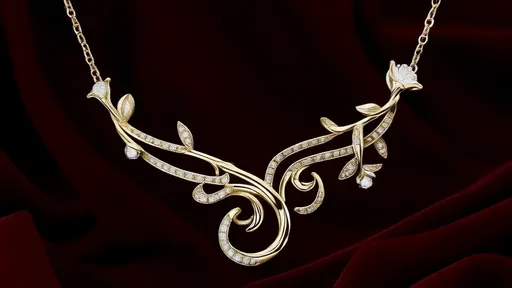
In the twilight of the 19th century, as industrialization stamped its rigid geometries across Europe, a rebellious artistic current emerged—one that worshipped the sinuous lines of nature rather than the machine's cold precision. Art Nouveau jewelry became the wearable manifesto of this movement, transforming precious metals and gemstones into fluid botanical fantasies that seemed to grow from the wearer's body rather than being crafted by human hands.
The movement's pioneers—visionaries like René Lalique, Georges Fouquet, and Lucien Gaillard—approached jewelry not as mere adornment but as miniature sculptures imbued with symbolic weight. Their workshops became laboratories where traditional goldsmithing techniques collided with radical new approaches to materiality. Enamels were layered like watercolor washes, horn and ivory coexisted with diamonds, and gold was manipulated to mimic the tender new growth of spring vines.
Nature served as both muse and religion for these artisans. Dragonflies with wings of plique-à-jour enamel hovered above brooches, their delicate veins catching light like stained glass. Orchids with petals of carved moonstones curled around women's throats in chokers that seemed to pulse with vegetative life. The female form itself frequently merged with floral elements—hair becoming vine tendrils, faces emerging from unfurling blossoms—in a celebration of organic unity that bordered on the mystical.
What set Art Nouveau jewelry apart from previous nature-inspired adornment was its philosophical underpinning. This wasn't mere floral decoration but an attempt to distill nature's fundamental energies into wearable form. The whiplash curve—that signature undulating line—wasn't just aesthetically pleasing; practitioners believed it represented the very essence of growth and movement found in plant stems, ocean waves, and even celestial phenomena.
The technical innovations required to realize these visions were staggering. Lalique pioneered techniques for molding glass directly into jewelry settings, creating pieces where translucent lily pads appeared to float above watery enamel backgrounds. The Japanese art of mokume-gane (wood-grain metal) was adapted to create dendritic patterns resembling fern fossils in silver. Goldsmiths developed specialized chasing tools to imprint the delicate textures of butterfly wings onto gold surfaces.
Critics initially dismissed these creations as frivolous decadence, but the movement's influence proved enduring. The 1900 Paris Exposition Universelle became Art Nouveau jewelry's triumphant debut, with Lalique's pavilion stopping visitors mid-stride. American heiresses and European aristocrats competed to commission the most daring pieces—a necklace with bats carved from black opal, a comb featuring a waterfall of silver-cast hair intertwined with enameled morning glories.
Today, museum retrospectives consistently draw record crowds for Art Nouveau jewelry exhibitions. Contemporary designers continue to mine its visual vocabulary, though few achieve the alchemical balance of technical mastery and poetic vision that characterized the originals. The finest pieces—like Lalique's iconic dragonfly woman corsage ornament in the Gulbenkian collection—retain their power to astonish, their delicate surfaces humming with the vitality of a movement that dared to make jewelry breathe.
The legacy persists not just in objects but in philosophy. In an age of mass production, Art Nouveau jewelry stands as a reminder that adornment can be transformative—not through sheer ostentation, but by forging an intimate connection between the human spirit and nature's eternal curves. Each piece was a tiny rebellion against the straight line, a manifesto in gold and enamel proclaiming that beauty grows wild.
By /Aug 19, 2025

By /Aug 11, 2025
By /Aug 11, 2025

By /Aug 11, 2025

By /Aug 11, 2025
By /Aug 11, 2025
By /Aug 11, 2025
By /Aug 11, 2025
By /Aug 11, 2025
By /Aug 11, 2025
By /Aug 11, 2025
By /Aug 11, 2025
By /Aug 11, 2025
By /Aug 11, 2025
By /Aug 11, 2025
By /Aug 11, 2025
By /Aug 11, 2025
By /Aug 11, 2025
By /Aug 11, 2025
By /Aug 11, 2025
