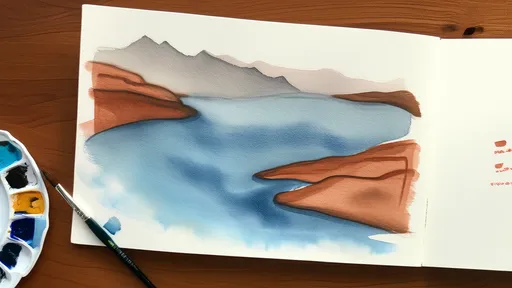
In the vast tapestry of Chinese artistic traditions, the boneless technique (mogu fa) stands as a mesmerizing departure from conventional ink-and-line painting. Unlike the rigid structures of meticulous brushwork or the bold strokes of calligraphic expression, this method embraces a fluid, almost poetic surrender to color and form. It is an art of suggestion rather than declaration, where pigments dance freely across silk or paper, unshackled by the confines of outlines.
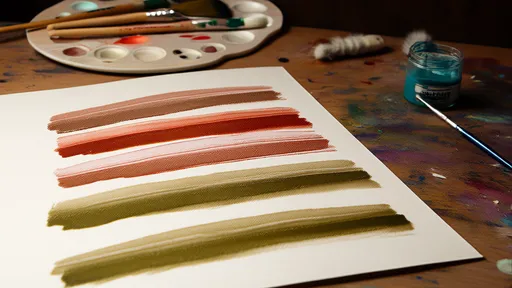
The term "boneless" might initially evoke a sense of fragility, yet in practice, it represents a bold reimagining of visual storytelling. Artists working in this style reject the skeletal framework of ink lines, instead relying on layered washes of mineral pigments, plant-based dyes, and delicate gradations of tone. The result is an ethereal quality—a painting that seems to breathe, its subjects emerging like mist at dawn or dissolving like twilight shadows.
Historical records trace the boneless method’s origins to the Five Dynasties period (907–960 CE), with Xu Chongsi and Huang Quan credited as early pioneers. However, it was during the Ming and Qing dynasties that the technique blossomed into full maturity. Court painters and literati alike experimented with its possibilities, particularly in floral and bird compositions. A peony might materialize from a single, voluptuous stroke of carmine, its petals implied through the pooling of pigment at the edges. A kingfisher’s iridescent plumage could be conjured through feather-light dabs of azurite and malachite, its form defined solely by chromatic contrast.
What makes this approach revolutionary is its philosophical underpinning. Traditional Chinese aesthetics often prioritized the "bone" (gu)—the structural essence conveyed through calligraphic lines. The boneless technique challenges this hierarchy by asserting that vitality (qi) can flow through color alone. It aligns with Daoist principles of spontaneity and the unforced harmony of nature. When observing a boneless painting, one doesn’t merely see a depiction of lotus flowers; one senses the humidity of a pond at midday, the way sunlight refracts through translucent petals.
Modern practitioners have expanded the technique’s vocabulary, incorporating textured papers and experimental pigments while maintaining its core ethos. Contemporary artist Lin Haizhong, for instance, employs crushed oyster shells mixed with traditional colors to create luminous, three-dimensional effects. Others blend the boneless approach with Western watercolor methods, producing hybrid works that resonate across cultures.
For collectors and scholars, these paintings present unique conservation challenges. Without the stabilizing presence of ink outlines, the organic pigments are prone to fading or shifting over time. Museums now use spectral imaging to study how original color relationships might have appeared centuries ago, revealing lost subtleties in masterpieces like Yun Shouping’s Album of Flowers.
The boneless technique’s legacy endures as both a technical marvel and a metaphysical inquiry. It asks viewers to reconsider how we perceive boundaries—between object and atmosphere, between artistry and accident. In an age increasingly defined by rigid binaries, this ancient yet ever-evolving tradition reminds us that some truths exist only in the liminal space where edges dissolve.
By /Aug 19, 2025

By /Aug 11, 2025
By /Aug 11, 2025
By /Aug 11, 2025

By /Aug 11, 2025
By /Aug 11, 2025
By /Aug 11, 2025
By /Aug 11, 2025
By /Aug 11, 2025
By /Aug 11, 2025
By /Aug 11, 2025
By /Aug 11, 2025
By /Aug 11, 2025
By /Aug 11, 2025
By /Aug 11, 2025
By /Aug 11, 2025
By /Aug 11, 2025
By /Aug 11, 2025
By /Aug 11, 2025
By /Aug 11, 2025
