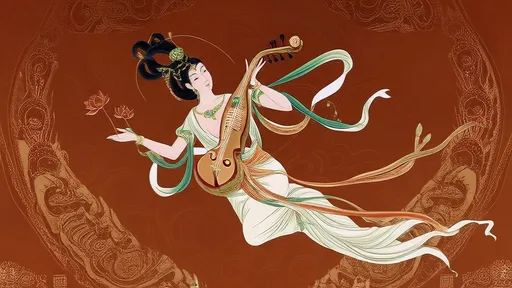
The ancient caves of Dunhuang, nestled along the Silk Road, have long been a treasure trove of Buddhist art, preserving centuries of cultural and spiritual expression. Among its most mesmerizing features are the celestial beings known as Feitian, or "flying apsaras," whose gravity-defying postures adorn the cave walls. A recent interdisciplinary study, Dunhuang Feitian Pose Spectrum: A Mechanical Analysis of Millennia-Old Dance Movements, delves into the biomechanics behind these ethereal figures, revealing how artists ingeniously captured motion and balance in static form.
For over a thousand years, the Feitian have captivated viewers with their flowing scarves, arched backs, and seemingly weightless suspension mid-air. The study, conducted by a team of art historians, physicists, and dance scholars, examines the interplay between artistic intent and physical principles. By analyzing the angles of limbs, the curvature of spines, and the drapery of garments, researchers uncovered how Dunhuang artists intuitively applied principles of center of mass and rotational dynamics to create the illusion of flight. The poses, though frozen in pigment and plaster, appear to defy gravity through precise compositional choices.
One striking revelation concerns the Feitian's signature "inverted U" posture, where the torso bends backward while the legs sweep upward. The research demonstrates that this configuration aligns with the natural trajectory of a body in freefall, mimicking the moment of suspension before descent. Artists amplified this effect by positioning the figures against swirling clouds or floral motifs, enhancing the perception of movement. The study also highlights regional variations—early Feitian from the Northern Wei dynasty exhibit stiffer, more angular forms, while Tang-era renditions showcase sinuous, dynamic curves, reflecting evolving dance aesthetics.
Beyond art history, the findings resonate with modern biomechanics. The Feitian's poses parallel movements in contemporary aerial dance and gymnastics, suggesting ancient observers had a sophisticated understanding of human kinetics. For instance, the "split-leg flutter" pose, where one leg extends forward and the other bends sharply, mirrors the angular momentum generated by divers mid-rotation. Researchers used 3D modeling to reconstruct these poses with virtual skeletons, confirming their anatomical plausibility despite the exaggerated stylization.
The study also addresses a lingering mystery: how did artists, working without formal physics training, achieve such accuracy? The answer may lie in Dunhuang's role as a cultural crossroads. Exposure to Indian, Persian, and Central Asian dance traditions likely provided empirical knowledge of body mechanics. Additionally, the caves served as meditation spaces—monks observing swirling incense or fluttering banners might have internalized patterns of motion later translated into art.
Critically, the research challenges the notion that pre-modern art was solely symbolic. The Feitian's poses weren’t just decorative; they encoded kinetic intelligence. A pose where the figure appears to push off from a cloud, for example, aligns with Newton’s third law (action-reaction), though conceived centuries before its formal articulation. This blurring of art and science underscores the ingenuity of Dunhuang’s creators, who merged spiritual aspiration with empirical observation.
Preservation concerns add urgency to the study. Climate change and tourism threaten the fragile pigments, making digital analysis crucial for safeguarding this heritage. The team employed photogrammetry to create millimeter-accurate reproductions of key Feitian, allowing future generations to study their mechanics even if the originals degrade. These digital models also enable "virtual restoration," testing how missing limbs or faded pigments might have originally contributed to the figures’ balance.
The project’s implications extend beyond academia. Choreographers have begun adapting Feitian poses for contemporary performances, fusing ancient aesthetics with modern dance. Meanwhile, robotics engineers explore how the Feitian’s weight distribution could inform agile drone design. This unexpected dialogue between past and present exemplifies how cultural heritage can inspire innovation.
As the study concludes, the Feitian endure not merely as religious icons but as testaments to humanity’s timeless fascination with transcending earthly bounds. Their flight, though painted on stone, continues to soar through the intersection of art, science, and imagination—a legacy as dynamic as the dances they depict.

By /Aug 19, 2025

By /Aug 11, 2025
By /Aug 11, 2025

By /Aug 11, 2025

By /Aug 11, 2025
By /Aug 11, 2025
By /Aug 11, 2025
By /Aug 11, 2025

By /Aug 11, 2025
By /Aug 11, 2025
By /Aug 11, 2025

By /Aug 11, 2025
By /Aug 11, 2025

By /Aug 11, 2025
By /Aug 11, 2025

By /Aug 11, 2025

By /Aug 11, 2025

By /Aug 11, 2025

By /Aug 11, 2025

By /Aug 11, 2025