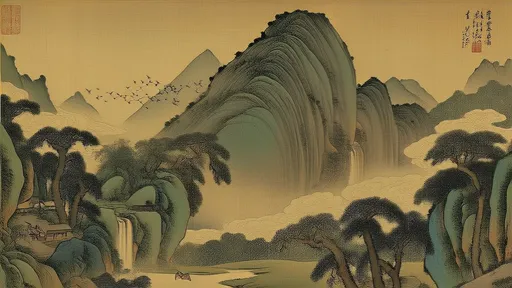
The Northern Song Dynasty (960–1127) represents a golden age in Chinese landscape painting, where artistic vision and philosophical depth converged to create enduring masterpieces. Among its many achievements, the era birthed what scholars now call the "Three Great Masters" – Li Cheng, Fan Kuan, and Guo Xi – whose works established compositional paradigms that would influence Chinese art for centuries. Their paintings weren't merely depictions of nature but visual manifestations of cosmological principles, where towering peaks and misty valleys embodied the harmony between heaven, earth, and humanity.
These artists developed distinct yet interconnected approaches to spatial organization that went beyond technical innovation. Fan Kuan's Travelers Among Mountains and Streams, for instance, employs a monumental verticality where the central mountain dominates two-thirds of the silk scroll, creating what later critics termed the "lofty distance" (gaoyuan) perspective. The composition's power derives from its deliberate imbalance – the sheer cliff face overwhelms the tiny human figures at its base, evoking the Neo-Confucian concept of nature's sublime indifference to human affairs.
Li Cheng's Reading the Stele demonstrates an alternative paradigm now called "level distance" (pingyuan). Unlike Fan's confrontational verticality, Li arranges elements horizontally across receding planes, inviting the viewer on a visual journey through layered space. His compositions often feature withered trees with "crab-claw" branches and "demon-face" knots – stylistic signatures that became codified in later painting manuals. The emotional resonance comes from subtle asymmetries; a scholar gazes at a weathered stele while his attendant looks away, creating narrative tension within the serene landscape.
Guo Xi, the youngest of the trio, synthesized their innovations in works like Early Spring, which exemplifies "deep distance" (shenyuan). His "angle-of-totality" technique combines multiple viewpoints within a single scroll – peaks viewed from below, mid-ground elements at eye level, and distant mountains seen as if from above. This compositional dynamism reflects his theoretical writings in Lofty Message of Forests and Streams, where he compares ideal landscapes to "a gentleman's virtuous mind": structured yet fluid, imposing yet approachable.
The secret grammar of these compositions lies in their treatment of negative space. Unlike Western perspective systems that privilege the viewer's fixed position, Song landscapes use ink washes and blank silk to suggest atmospheric qi (energy) flowing between forms. In Fan Kuan's work, mist isolates the central peak like a celestial throne; Li Cheng employs voids to imply continuation beyond the scroll's edges; Guo Xi's swirling clouds guide the eye along predetermined visual pathways. This "breathing space" creates what 11th-century critics called "living rhythm" (qiyun), transforming static images into meditative experiences.
Recent multispectral imaging of Fan Kuan's masterpiece revealed underdrawings that confirm the calculated nature of these compositions. Grid lines and proportional markers show how the "three distances" theory was systematically applied, with key elements positioned according to the golden ratio. The foreground boulder occupies exactly 38% of the lower register – not by accident, but to create deliberate tension with the mountain's mass. Such findings underscore how these artists balanced spontaneity with mathematical precision, a duality central to Chinese aesthetic philosophy.
Modern viewers often miss the political subtext encoded in these landscapes. The towering central peaks in Fan Kuan's works mirrored the imperial bureaucracy's hierarchical structure, while Li Cheng's scholar-recluses embodied the educated elite's dual role as government servants and spiritual seekers. Guo Xi, who served as court painter to Emperor Shenzong, explicitly linked compositional principles to social order in his treatise: "As a mountain has its principal peak, so a state has its sovereign." The paintings' tranquil surfaces thus concealed sophisticated ideological statements about power, duty, and withdrawal.
The legacy of these compositional strategies endured well beyond the Song collapse. When 14th-century Yuan dynasty literati painters rejected courtly styles, they ironically retained the "three distances" framework while inverting its meanings – using sparse brushwork to convey political dissent. Even in contemporary Chinese art, traces of this visual language persist; digital media artist Yang Yongliang's Artificial Wonderland series reconstructs Song mountain compositions using photographs of urban sprawl, proving the paradigm's adaptability across millennia.
What makes the Northern Song approach unique in global art history is its fusion of technical mastery with metaphysical ambition. Unlike European Renaissance perspective that sought to replicate human vision, or Islamic geometric abstraction representing divine order, Song painters created a middle way – landscapes that felt simultaneously real and symbolic, immediate and eternal. The "three distances" weren't just viewing angles but pathways to enlightenment, inviting viewers to mentally traverse the painting as a Daoist might journey through sacred mountains.
As museums increasingly display these works alongside global masterpieces, new audiences discover their sophisticated visual language. The 2023 Metropolitan Museum exhibition "Mountains That Speak" demonstrated how Fan Kuan's compositional tension parallels Cézanne's Mont Sainte-Victoire series, while Li Cheng's spatial pauses resonate with Rothko's color fields. Such cross-cultural dialogues affirm the Three Great Masters' enduring relevance – their mountains still speak, if we learn to listen.
By /Aug 19, 2025

By /Aug 11, 2025
By /Aug 11, 2025
By /Aug 11, 2025
By /Aug 11, 2025
By /Aug 11, 2025
By /Aug 11, 2025
By /Aug 11, 2025
By /Aug 11, 2025
By /Aug 11, 2025
By /Aug 11, 2025

By /Aug 11, 2025
By /Aug 11, 2025

By /Aug 11, 2025
By /Aug 11, 2025
By /Aug 11, 2025
By /Aug 11, 2025

By /Aug 11, 2025
By /Aug 11, 2025
By /Aug 11, 2025
