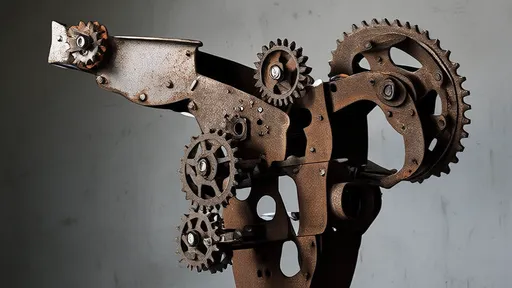
In the realm of contemporary art, few mediums capture the spirit of transformation as vividly as metal welding sculpture. What was once discarded as industrial waste—rusted gears, bent pipes, and shattered machine parts—finds new life under the torch of a welder’s hand. This art form, often overlooked in traditional galleries, thrives in the intersection of craftsmanship and environmental consciousness, where scrap iron is not merely recycled but reimagined.
The process begins with scavenging. Artists comb through junkyards, abandoned factories, and construction sites, seeking materials with hidden potential. A twisted beam becomes a sinewy muscle; a cluster of bolts transforms into a swarm of insects. There’s an alchemy here, where the weight of history—the factory labor, the mechanical failures, the passage of time—is preserved even as the metal is reborn. The sculptor’s eye sees not decay but raw material, waiting to be reassembled into something wholly new.
Welding itself is a dance of precision and improvisation. Unlike marble carving or bronze casting, where mistakes can be catastrophic, welded sculpture allows for adjustments mid-creation. The artist might fuse two pieces, step back, then angle a third fragment to alter the composition entirely. This fluidity mirrors the ethos of the medium: nothing is permanent, not even the act of creation. Sparks fly, metals warp, and the sculpture evolves in real time, often revealing its final form only in the last moments of work.
The aesthetic of welded scrap iron is inherently paradoxical. It celebrates roughness—the pitted surfaces, the jagged edges—while demanding meticulous craftsmanship. A poorly executed weld can ruin the structural integrity of a piece, yet too much polish can strip away the raw energy that defines the genre. The best works strike a balance, honoring the material’s industrial past while elevating it to the realm of art. Think of Eduardo Paolozzi’s chaotic robot-like figures or David Smith’s geometric abstractions: both artists embraced the "flaws" of their materials, turning rust and asymmetry into visual language.
Critics often debate whether welded sculpture belongs to the past or the future. Its materials are undeniably tied to the 20th century’s industrial age, yet its ethos—sustainability, adaptability, repurposing—feels urgently contemporary. In an era of climate crisis, artists working with scrap metal are unwitting environmentalists. Their work asks: What do we discard, and why? What might we build from the fragments? A welded sculpture of a tree made from car parts isn’t just a visual metaphor; it’s a quiet protest against waste.
Perhaps the most compelling aspect of this art form is its accessibility. Unlike traditional sculpture, which often requires expensive materials and foundries, welded art can emerge from a backyard workshop. Self-taught artists thrive in this space, their lack of formal training becoming an asset rather than a limitation. There’s a democratic spirit here, a reminder that art isn’t confined to museums—it can rise from a pile of rubble, sparked into being by imagination and a welding torch.
As exhibitions increasingly feature welded sculptures alongside paintings and digital art, the medium is gaining recognition as a vital thread in the tapestry of contemporary art. Galleries in post-industrial cities—Detroit, Sheffield, Dortmund—have become hubs for this movement, showcasing works that pulse with the energy of their reclaimed materials. The message is clear: beauty isn’t something we create from nothing. It’s something we uncover, piece by piece, in what the world has thrown away.
By /Aug 19, 2025

By /Aug 11, 2025
By /Aug 11, 2025
By /Aug 11, 2025
By /Aug 11, 2025
By /Aug 11, 2025

By /Aug 11, 2025
By /Aug 11, 2025

By /Aug 11, 2025
By /Aug 11, 2025
By /Aug 11, 2025
By /Aug 11, 2025
By /Aug 11, 2025
By /Aug 11, 2025
By /Aug 11, 2025

By /Aug 11, 2025
By /Aug 11, 2025

By /Aug 11, 2025
By /Aug 11, 2025
By /Aug 11, 2025
