For centuries, the silent sentinels of history have watched over us from temple walls, cave ceilings, and palace corridors. These ancient murals, vibrant despite the passage of millennia, owe their longevity to an often-overlooked foundation: the humble plaster base known as dizhangceng in Chinese conservation terminology. This unassuming layer between wall and pigment holds secrets that modern science is only beginning to comprehend.
Archaeologists and conservators working at Dunhuang's Mogao Caves made a startling discovery in 2018. Beneath flaking pigments of a 1,400-year-old Buddhist mural, they found the plaster layer intact - still flexible enough to bend slightly under pressure. This remarkable resilience stems from an ancient recipe combining clay, sand, plant fibers, and organic additives that have baffled modern material scientists. The precise formulation varies across regions and dynasties, with each culture developing its own version of this durable undercoat.
Traditional plaster recipes reveal a sophisticated understanding of material science that predates modern chemistry by centuries. In Tibet, artisans mixed yak milk and barley flour into their plaster. Along the Silk Road, crushed eggshells appear as a common additive. The Ajanta Caves in India showcase plasters containing rice husks and local gums. These organic components create a microstructure that allows the plaster to "breathe," expanding and contracting with humidity changes without cracking.
Modern analysis shows these ancient plasters achieve what contemporary conservation science struggles to replicate - a perfect balance between flexibility and rigidity. Electron microscope images reveal how plant fibers create a three-dimensional network within the clay matrix, functioning much like the rebar in concrete. The organic additives appear to slow crystallization within the plaster, preventing the formation of large, brittle mineral structures.
Perhaps most astonishing is how these ancient artisans engineered their plasters for specific environments. Coastal temple murals in Southeast Asia contain crushed seashells that neutralize salt damage. Desert monasteries along the Silk Road feature plaster that actively absorbs moisture during rare rains then slowly releases it. These site-specific formulations demonstrate an environmental awareness we've only recently rediscovered in sustainable architecture.
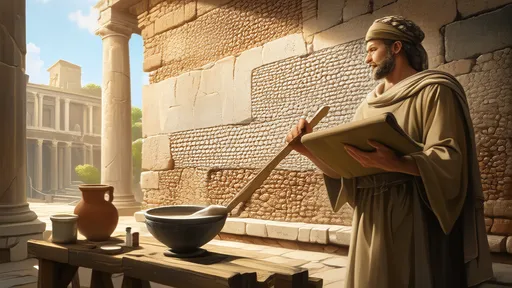
The preparation process itself was often ritualistic. Historical records describe Tibetan monks chanting sutras while mixing plaster, believing spiritual energy could transfer into the material. Chinese texts from the Tang Dynasty prescribe specific lunar phases for gathering ingredients. While modern science dismisses these practices as superstition, recent experiments suggest rhythmic vibration during mixing may indeed improve the plaster's homogeneity.
Contemporary conservation faces a dilemma when repairing ancient murals. Synthetic plasters, while consistent and predictable, lack the dynamic properties of traditional mixtures. Some European conservators report that modern repairs often fail within decades while original plaster survives centuries. This has sparked renewed interest in ancient recipes among international conservation bodies.
At the Vatican's conservation laboratory, experts have begun experimenting with modified versions of Song Dynasty plaster formulas to preserve Renaissance frescoes. Early results show promising compatibility between the Asian technique and European wall paintings. Similarly, the Getty Conservation Institute has incorporated camel hair fibers - a traditional Central Asian additive - into their desert site preservation projects.
The most valuable lesson from these ancient plaster recipes may not be their specific ingredients, but their philosophical approach. Traditional artisans viewed the plaster as a living system rather than inert material, formulating each batch to suit its specific context and purpose. In an era of standardized building materials, this customized, locally-sourced approach offers profound insights for sustainable conservation.
As laser scanning and 3D printing technologies allow us to document and replicate ancient murals with unprecedented precision, the humble plaster foundation reminds us that true preservation requires understanding not just the visible art, but the invisible infrastructure that sustains it. The next frontier in mural conservation may lie not in advanced technologies, but in decoding and adapting these time-tested ancient recipes for the challenges of our changing climate.
Museum collections worldwide hold thousands of plaster samples from archaeological sites, most never thoroughly analyzed. Advanced materials science techniques like synchrotron radiation micro-computed tomography could reveal their secrets at the nanoscale. What began as a simple mixture of earth and water has become a bridge connecting ancient craftsmanship with cutting-edge science, proving that sometimes the oldest solutions are the most revolutionary.

By /Aug 19, 2025

By /Aug 11, 2025
By /Aug 11, 2025
By /Aug 11, 2025
By /Aug 11, 2025
By /Aug 11, 2025

By /Aug 11, 2025

By /Aug 11, 2025

By /Aug 11, 2025
By /Aug 11, 2025
By /Aug 11, 2025
By /Aug 11, 2025

By /Aug 11, 2025
By /Aug 11, 2025
By /Aug 11, 2025

By /Aug 11, 2025
By /Aug 11, 2025
By /Aug 11, 2025
By /Aug 11, 2025
By /Aug 11, 2025
